06: Strings and Unicode
Audience: All Time: 90 minutes Prerequisites: 01-05 You'll learn: String operations, Unicode, formatting, pattern matching with regex
The Big Picture
Strings are how programs work with text. Zebra treats strings as: - Unicode-aware — Emoji, Chinese, Arabic, etc. all work correctly - First-class — Rich library of methods - Immutable — Can't change them after creation (create new ones instead) - Efficient — UTF-8 encoding optimizes storage
String Basics
String Literals
// file: 06_string_basics.zbr
// teaches: string creation // chapter: 06-Strings-and-Unicode
class Main     shared         def main             // Simple string             var greeting = "Hello"             print greeting
            // With quotes inside             var quoted = "She said \"Hello\""             print quoted
            // Multi-line (if supported)             var poem = """             Roses are red             Violets are blue             """             print poem
            // Escape sequences             var path = "C:\\Users\\Name\\Documents"             var tab = "Name\tAge\tCity"             var newline = "Line1\nLine2"
String Properties
// file: 06_string_props.zbr
// teaches: string properties and methods // chapter: 06-Strings-and-Unicode
class Main     shared         def main             var text = "Hello, World!"
            // Length             print text.len                      // 13
            // Character at index             var first_char = text[0]             print first_char                    // H
            // Substring/slice             var part = text[0..4]             print part                          // Hello
            // Case conversion             print text.upper()                  // HELLO, WORLD!             print text.lower()                  // hello, world!
String Interpolation
// file: 06_interpolation.zbr
// teaches: string interpolation // chapter: 06-Strings-and-Unicode
class Main     shared         def main             var name = "Alice"             var age = 30
            // Simple interpolation             print "Name: ${name}"               // Name: Alice
            // Expressions in interpolation             print "Age next year: ${age + 1}"   // Age next year: 31
            // Method calls             var lower_name = name.lower()             print "Lowercase: ${lower_name}"    // Lowercase: alice
            // Format specifiers (if supported)             var price = 19.99             print "Price: ${price:.2f}"         // Price: 19.99
String Methods
Searching
// file: 06_search.zbr
// teaches: searching in strings // chapter: 06-Strings-and-Unicode
class Main     shared         def main             var text = "Hello, World!"
            // Contains             print text.contains("World")        // true             print text.contains("xyz")          // false
            // Index             var idx = text.indexOf("World")             print idx                           // 7
            // Not found returns -1 or special value             var not_found = text.indexOf("xyz")             print not_found
            // Starts/ends with             print text.startsWith("Hello")      // true             print text.endsWith("!")            // true
Splitting and Joining
// file: 06_split_join.zbr
// teaches: splitting and joining strings // chapter: 06-Strings-and-Unicode
class Main     shared         def main             // Split             var csv = "apple,banana,cherry"             var fruits = csv.split(",")             for fruit in fruits                 print fruit
            // Join             var items as List(str) = List()             items.add("one")             items.add("two")             items.add("three")             var result = ", ".join(items)             print result                        // one, two, three
Trimming and Padding
// file: 06_trim_pad.zbr
// teaches: trimming and padding // chapter: 06-Strings-and-Unicode
class Main     shared         def main             var padded = "  hello  "
            // Trim whitespace             print "|${padded.trim()}|"          // |hello|             print "|${padded.trimLeft()}|"      // |hello  |             print "|${padded.trimRight()}|"     // |  hello|
            // Padding             var short = "hi"             print short.padLeft(10, "*")        // hi             print short.padRight(10, "-")       // hi--------             print short.center(10, "*")         // hi
Replacing
// file: 06_replace.zbr
// teaches: string replacement // chapter: 06-Strings-and-Unicode
class Main     shared         def main             var text = "cat and dog and bird"
            // Replace (first occurrence, or all)             var once = text.replace("and", "or")      // Replaces once             print once
            var all = text.replaceAll("and", "or")    // Replaces all             print all
            // Case conversion replacement             var lower = "Hello World".lower()             print lower                         // hello world
Unicode and Internationalization
Unicode Basics
// file: 06_unicode.zbr
// teaches: unicode support // chapter: 06-Strings-and-Unicode
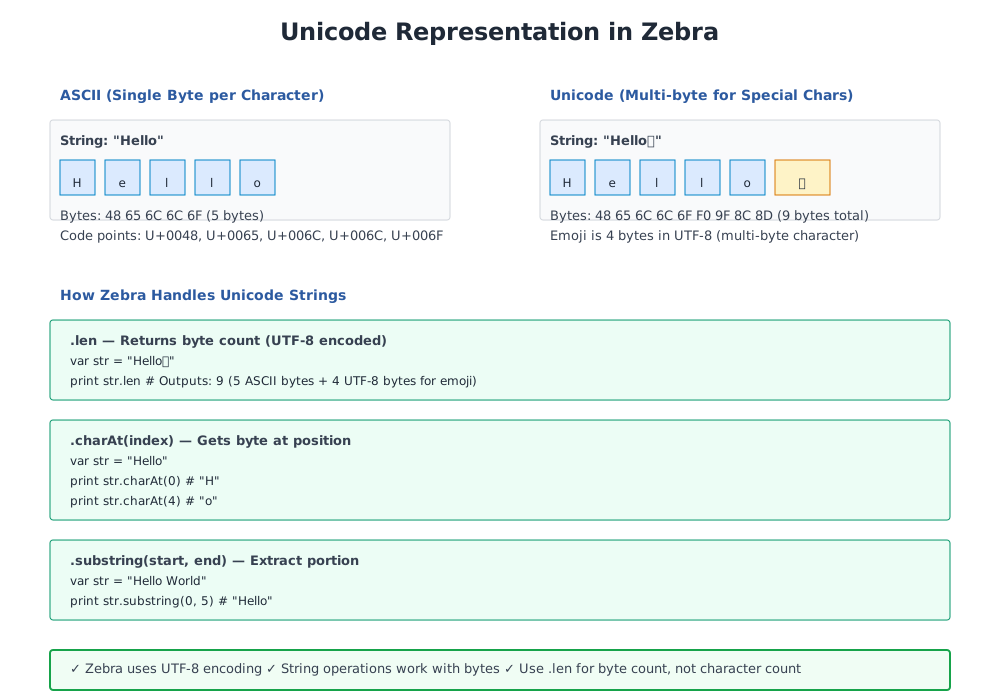
class Main     shared         def main             // Emoji             var emoji = "Hello 👋 🌍 🎉"             print emoji             print emoji.len                     // Byte length             print emoji.codePointCount()        // Character count
            // Chinese             var chinese = "你好世界"  // Hello World in Chinese             print chinese
            // Arabic (right-to-left)             var arabic = "مرحبا بالعالم"  // Hello World             print arabic
            // Mixed scripts             var mixed = "Hello 世界 مرحبا"             print mixed
Character Iteration
// file: 06_char_iter.zbr
// teaches: iterating over characters // chapter: 06-Strings-and-Unicode
class Main     shared         def main             var text = "Hello"
            // Iterate characters             for char in text.chars()                 print char
            // Byte iteration             var data = "AB"             for byte in data.bytes()                 print byte                      // 65, 66 (ASCII values)
Regular Expressions (Intro)
Regular expressions let you search and validate text patterns.
Basic Patterns
// file: 06_regex_intro.zbr
// teaches: regular expressions introduction // chapter: 06-Strings-and-Unicode
class Main     shared         def main             // Simple pattern             var email = "alice@example.com"             var pattern = Regex.compile("[a-z]+@[a-z]+\\.[a-z]+")
            var is_valid = pattern.match(email)             print is_valid                      // true
            // Find matches             var text = "I have 2 apples and 3 oranges"             var digit_pattern = Regex.compile("\\d+")             var found = digit_pattern.find(text)             print found                         // 2
            // Replace             var clean = digit_pattern.replace(text, "X")             print clean                         // I have X apples and X oranges
Real World: Text Processing
// file: 06_text_processing.zbr
// teaches: practical text operations // chapter: 06-Strings-and-Unicode
class Parser     shared         def parse_csv_line(line as str) as List(str)             return line.split(",")
        def normalize_whitespace(text as str) as str             // Replace multiple spaces with one             var lines as List(str) = List()             for line in text.split("\n")                 var trimmed = line.trim()                 if trimmed.len > 0                     lines.add(trimmed)             return "\n".join(lines)
        def extract_numbers(text as str) as List(str)             var results as List(str) = List()             var pattern = Regex.compile("\\d+")             for match in pattern.findAll(text)                 results.add(match)             return results
class Main     shared         def main             // Parse CSV             var csv_line = "Alice,30,alice@example.com"             var fields = Parser.parse_csv_line(csv_line)             print "Name: ${fields.at(0)}"             print "Age: ${fields.at(1)}"
            // Extract numbers             var text = "I was born in 1990 and moved in 2005"             var years = Parser.extract_numbers(text)             for year in years                 print year
Common Patterns
Email Validation
def is_valid_email(email as str) as bool
    if not email.contains("@")         return false     var parts = email.split("@")     if parts.count() != 2         return false     if not parts.at(1).contains(".")         return false     return true
URL Parsing
def parse_url(url as str) as HashMap(str, str)
    var result as HashMap(str, str) = HashMap()     var parts = url.split("://")     if parts.count() == 2         result.put("protocol", parts.at(0))     return result
String Templating
def template(text as str, values as HashMap(str, str)) as str
    var result = text     for key, value in values         var placeholder = "${${key}}"         result = result.replace(placeholder, value)     return result
Common Mistakes
> ❌ Mistake: Forgetting that strings are immutable > >
> var text = "hello" > text[0] = 'H' # ❌ Can't modify > > var text = "hello" > var capitalized = "H".concat(text[1..]) > > ❌ Mistake: Ignoring Unicode length > >
> var emoji = "👋" > print emoji.len # ❌ Returns 4 (bytes), not 1 > > var emoji = "👋" > print emoji.codePointCount() # ✅ Returns 1 (characters) > > ❌ Mistake: Inefficient concatenation in loops > >
> var result = "" > for i in 1..1000 > result = result + "${i}," # ❌ O(n²) complexity > > var sb as StringBuilder = StringBuilder() > for i in 1..1000 > sb.append("${i},") > var result = sb.build() # ✅ O(n) complexity > Exercises
Exercise 1: String Reversal
Write a function that reverses a string:
Solution
class Reverser
    shared         def reverse(text as str) as str             var chars as List(str) = List()             for c in text.chars()                 chars.add(c.toString())
            var result = ""             var i = chars.count() - 1             while i >= 0                 result = result.concat(chars.at(i))                 i = i - 1             return result
class Main     shared         def main             var reversed = Reverser.reverse("hello")             print reversed  // olleh
Exercise 2: Email Validator
Write a simple email validator:
Solution
class Validator
    shared         def is_valid_email(email as str) as bool             if email.len < 5                 return false             if not email.contains("@")                 return false             if not email.contains(".")                 return false             var parts = email.split("@")             if parts.count() != 2                 return false             if parts.at(1).len < 3                 return false             return true
class Main     shared         def main             var emails as List(str) = List()             emails.add("alice@example.com")             emails.add("invalid")             emails.add("bob@domain.co")
            for email in emails                 if Validator.is_valid_email(email)                     print "Valid: ${email}"                 else                     print "Invalid: ${email}"
Exercise 3: CSV Parsing
Parse a CSV line and extract fields:
Solution
class CSVParser
    shared         def parse(line as str) as List(str)             return line.split(",")
        def parse_with_trim(line as str) as List(str)             var raw = line.split(",")             var trimmed as List(str) = List()             for field in raw                 trimmed.add(field.trim())             return trimmed
class Main     shared         def main             var csv = "Alice, 30, NYC"             var fields = CSVParser.parse_with_trim(csv)             for field in fields                 print "|${field}|"
Next Steps
- → 07-Classes — Object-oriented programming - → 18-Regular-Expressions — Deep dive into regex - 🏋️ Project-1-CLI-Tool — Text processing practical application
Key Takeaways
- Strings are immutable — Create new ones instead of modifying - Interpolation is readable — Use "${var}" over concatenation - Methods are rich — .split(), .replace(), .trim(), etc. - Unicode works seamlessly — emoji, Chinese, Arabic, etc. - Regex enables pattern matching — For validation and extraction - StringBuilder is efficient — Use for loop-based concatenation
Next: Head to Part 2 for object-oriented programming with 07-Classes.