13: Generics and Type Constraints
Audience: Experienced programmers Time: 120 minutes Prerequisites: 02-Values-and-Types, 08-Interfaces-and-Protocols You'll learn: Generic types, type parameters, constraints, practical uses, common pitfalls
The Big Picture
So far, you've written code that works with specific types: a List(int), a HashMap(str, int). But what if you want a function that works with any type? That's where generics come in.
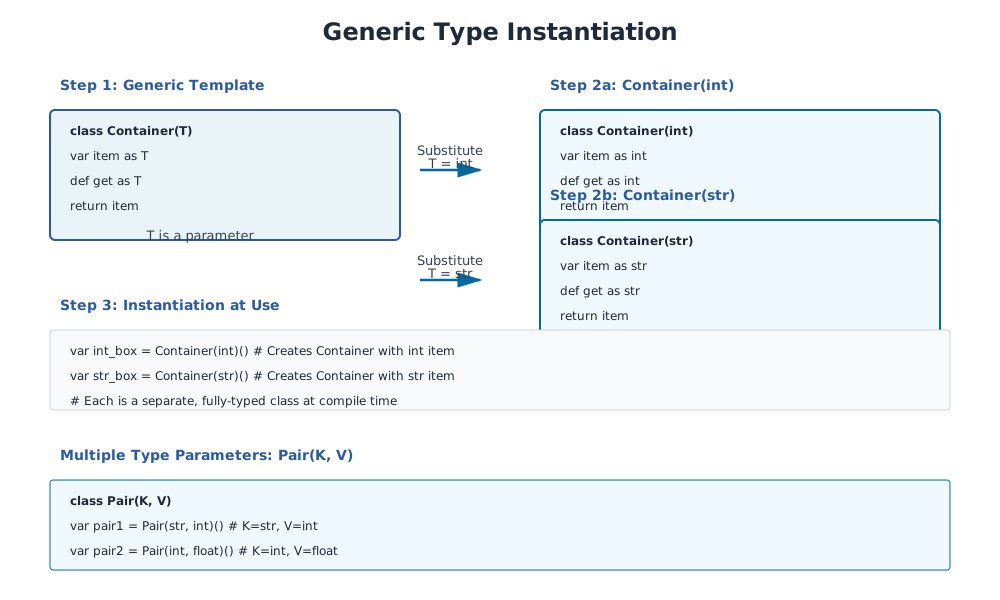
Generics let you write code that's type-safe but reusable across different types:
class Container(T)
    var item as T
    def get as T         return item
Container(int) holds integers. Container(str) holds strings. Same code, different types. This is safer than using object or any, because the type checker still verifies you don't mix types.
Generic Classes
The simplest generic is a container that holds a single value:
// file: 13_generic_container.zbr
// teaches: generic class definition // chapter: 13-Generics-and-Type-Constraints
class Container(T)     var item as T
    def set(value as T)         item = value
    def get as T         return item
class Main     shared         def main             var int_box = Container(int)()             int_box.set(42)             print int_box.get()  # Output: 42
            var str_box = Container(str)()             str_box.set("hello")             print str_box.get()  # Output: hello
Notice the syntax: - Container(T) — T is a type parameter - Container(int)() — substitute int for T, then create an instance - Inside the class, T can be used like any other type
You can have multiple type parameters:
// file: 13_generic_pair.zbr
// teaches: multiple type parameters // chapter: 13-Generics-and-Type-Constraints
class Pair(K, V)     var key as K     var value as V
    def set_key(k as K)         key = k
    def set_value(v as V)         value = v
    def get_key as K         return key
    def get_value as V         return value
class Main     shared         def main             var p = Pair(str, int)()             p.set_key("count")             p.set_value(42)             print "Key: ${p.get_key()}, Value: ${p.get_value()}"
Generic Methods
You can also write generic methods within regular classes:
// file: 13_generic_methods.zbr
// teaches: generic methods // chapter: 13-Generics-and-Type-Constraints
class Utils     shared         def identity(value as T) as T             return value
        def first_of_three(a as T, b as T, c as T) as T             return a
class Main     shared         def main             var x = Utils.identity(42)             print x  # Output: 42
            var y = Utils.identity("hello")             print y  # Output: hello
            var z = Utils.first_of_three(1, 2, 3)             print z  # Output: 1
The type parameter T is inferred from the arguments you pass.
Generic Collections
You already use generics implicitly with List and HashMap:
// file: 13_generic_collections.zbr
// teaches: using generic stdlib types // chapter: 13-Generics-and-Type-Constraints
class Main     shared         def main             var numbers as List(int) = List()             numbers.add(1)             numbers.add(2)             numbers.add(3)
            for n in numbers                 print n
            var ages as HashMap(str, int) = HashMap()             ages.put("Alice", 30)             ages.put("Bob", 25)
            for name, age in ages                 print "${name}: ${age}"
These are all generic types. The standard library provides them pre-built.
Type Constraints
Sometimes you want a generic that works with any type that implements an interface:
// file: 13_type_constraints.zbr
// teaches: interface constraints // chapter: 13-Generics-and-Type-Constraints
interface Printable     def display as str
class Dog     implements Printable         def display as str             return "Woof!"
class Cat     implements Printable         def display as str             return "Meow!"
class Printer     shared         def print_item(item as Printable)             print item.display()
class Main     shared         def main             var dog = Dog()             var cat = Cat()
            Printer.print_item(dog)  # Output: Woof!             Printer.print_item(cat)  # Output: Meow!
Here, Printer.print_item accepts any type that implements Printable. This is a constraint: "T must implement interface Printable".
More advanced: constraints on generic methods:
// file: 13_generic_constraints_advanced.zbr
// teaches: constraints in generic methods // chapter: 13-Generics-and-Type-Constraints
interface Comparable     def compare_to(other as this) as int
class ComparableList(T)     var items as List(T) = List()
    def add(item as T)         items.add(item)
    def find_max as T?         if items.count() == 0             return nil         var max = items.at(0)         var i = 1         while i < items.count()             var item = items.at(i)             # Here, T must implement Comparable             if item.compare_to(max) > 0                 max = item             i = i + 1         return max
class Main     shared         def main             var list = ComparableList(int)()             list.add(10)             list.add(5)             list.add(20)             var max = list.find_max()             if max != nil                 print "Max: ${max}"
Real World: Generic Cache
A practical example: a cache that works with any type:
// file: 13_generic_cache.zbr
// teaches: realistic generic class // chapter: 13-Generics-and-Type-Constraints
class Cache(K, V)     var data as HashMap(K, V) = HashMap()     var max_size as int
    def init(max_size as int)         this.max_size = max_size
    def put(key as K, value as V)         if data.count() >= max_size and not data.contains(key)             # Evict first key (simplistic LRU simulation)             # In real code, track access order             pass         data.put(key, value)
    def get(key as K) as V?         if data.contains(key)             return data.fetch(key)         return nil
    def clear         data = HashMap()
class Main     shared         def main             var cache = Cache(str, int)()             cache.init(3)             cache.put("a", 1)             cache.put("b", 2)             cache.put("c", 3)
            var val = cache.get("b")             if val != nil                 print "Got: ${val}"
Common Mistakes
Mistake 1: Forgetting to Instantiate Generic Parameters
// WRONG
var box = Container()  # Error: T not specified box.set(42)
// CORRECT var box = Container(int)() box.set(42)
Mistake 2: Mixing Types in a Generic Container
// WRONG
var box = Container(int)() box.set("hello")  # Error: Expected int, got str
// CORRECT var box = Container(str)() box.set("hello")
Mistake 3: Using Constraints Incorrectly
// WRONG - method doesn't actually require Comparable
def find_max(items as List(T)) as T     var max = items.at(0)     var item = items.at(1)     if item > max  # Error: > not defined for all T         max = item     return max
// CORRECT - either don't use >, or require Comparable interface def find_max(items as List(T)) as T     var max = items.at(0)     for item in items         if item.toString() > max.toString()  # Convert to string for comparison             max = item     return max
Mistake 4: Type Erasure at Runtime
// DANGER - at runtime, type information is lost
def process(items as List(T))     for item in items         if item isa int  # This may not work as expected             print item + 10
In Zebra, type parameters are erased during code generation to Zig. Use interfaces to encode types you need at runtime.
Exercises
Exercise 1: Generic Stack
Implement a Stack(T) class with push, pop, and is_empty methods:
Solution
class Stack(T)
    var items as List(T) = List()
    def push(value as T)         items.add(value)
    def pop as T?         if items.count() == 0             return nil         var value = items.at(items.count() - 1)         # Remove last item (simplified - no remove method)         return value
    def is_empty as bool         return items.count() == 0
class Main     shared         def main             var stack = Stack(int)()             stack.push(1)             stack.push(2)             stack.push(3)
            var val = stack.pop()             if val != nil                 print "Popped: ${val}"
Exercise 2: Generic Filter Function
Write a function that filters a list based on a predicate (function that returns bool):
Solution
class ListUtils
    shared         def filter(items as List(T), predicate as T -> bool) as List(T)             var result as List(T) = List()             for item in items                 if predicate(item)                     result.add(item)             return result
class Main     shared         def main             var numbers as List(int) = List()             numbers.add(1)             numbers.add(2)             numbers.add(3)             numbers.add(4)
            var is_even as T -> bool = { x in x % 2 == 0 }             var evens = ListUtils.filter(numbers, is_even)
            for e in evens                 print e
Exercise 3: Generic Wrapper with Validation
Create a ValidatedBox(T) that only accepts values passing a validation function:
Solution
class ValidatedBox(T)
    var item as T?     var validator as T -> bool
    def init(validator as T -> bool)         this.validator = validator
    def set(value as T) as bool         if validator(value)             item = value             return true         return false
    def get as T?         return item
class Main     shared         def main             var age_box = ValidatedBox(int)()             age_box.init({ x in x >= 0 and x <= 150 })
            if age_box.set(25)                 print "Valid age: ${age_box.get()}"
            if not age_box.set(200)                 print "Invalid age"
Key Takeaways
- Generics enable type-safe reusable code — Write once, use with many types - Type parameters are like function parameters — Container(T) where T is filled in at use time - Collections are generics — List(T), HashMap(K, V) work with any type - Constraints limit generics — Use interfaces to require specific capabilities - Type erasure happens at compile time — Don't rely on runtime type information
Next Steps
- → 14-Contracts — Express what generics must provide - → 15-Pipelines — Chain generic operations cleanly - → Project 1 — Use generics in real code
Generics are the bridge between flexibility and safety. Master them, and your code scales.