12: Error Handling
Audience: All
Time: 120 minutes
Prerequisites: 02-Values, 04-Functions, 07-Classes, 11-Nil-Tracking
You'll learn: throws annotation, raise statement, method-level catch clauses, error propagation, inline catch expressions
The Big Picture
Zebra's error model is exceptions — throws/raise/try/catch.
The shape is inspired by Zig's error-set system (each throws function returns
anyerror!T in the generated Zig), but enriched: raise "msg" carries a
string message, and raise "msg", obj attaches a structured details object
via a thread-local _error_ctx — strictly more than Zig's payload-less
error enums.
Error paths are explicit in the type system: throws on a signature is the
only way a function can fail, so you can see at a glance which functions may
fail and which cannot.
Note: Earlier versions of Zebra exposed a
Result(T)type as an error-as-value alternative. That type and its.isOk()/.okValue()methods were removed. Usethrowsfor all error handling.
Functions That Can Fail: throws
Mark a function with throws to indicate it may produce an error:
# file: 12_throws_basic.zbr
# teaches: throws annotation
# chapter: 12-Error-Handling

class Validator
    static
        def parse_int(text: str): int throws
            if text.len == 0
                raise "Empty string"
            # Parse and return
            return 42

def main()
    var result = Validator.parse_int("123") catch 0
    print(result)
Breakdown:
: int throws— This function returnsintbut may failraise "Empty string"— Signal an error with a messagecatch 0— If the call fails, use0as the fallback value
raise — Signaling Errors
Use raise to signal that something went wrong:
# file: 12_raise.zbr
# teaches: raise statement
# chapter: 12-Error-Handling

class FileLoader
    static
        def load(path: str): str throws
            if path.len == 0
                raise "Path cannot be empty"
            if not path.endsWith(".txt")
                raise "Only .txt files supported"
            return "file contents here"
raise immediately exits the function and propagates the error to the caller.
Method-Level catch — Handling Errors
Block Form
For structured error handling, attach a catch clause to a method (or def)
at the same indent level as the def keyword. The clause runs when any
throws call inside the method body raises:
# file: 12_method_catch.zbr
# teaches: method-level catch clause
# chapter: 12-Error-Handling

def attempt()
    var value = Validator.parse_int("")
    print("Got: ${value}")
catch
    print("Failed to parse")

def main()
    attempt()
Catch with Binding
Bind the error value to inspect it. The binding gives you an error object with
a .message field (a plain string binding, |err|, prints the whole error via
interpolation; .message is how you pull just the text out):
# file: 12_catch_binding.zbr
# teaches: catch with error binding
# chapter: 12-Error-Handling

def attempt()
    var value = Validator.parse_int("")
    print("Got: ${value}")
catch |err|
    print("Error: ${err.message}")

def main()
    attempt()
Note: Earlier Zebra versions allowed a
try ... catch ...block at any point inside a method body, and a typed error binding written|err as str|. Both forms were removed; today everycatchclause attaches to either adef(method-level) or a single expression (inline postfixexpr catch fallback), and the binding is untyped — use|err|and read.message.
catch Expression — Inline Fallbacks
For simple cases, use catch as an expression to provide a default:
# file: 12_catch_expr.zbr
# teaches: catch expression for defaults
# chapter: 12-Error-Handling

def main()
    # Provide a default value if the call fails
    var value = Validator.parse_int("abc") catch 0
    print(value)  # 0

    var count = Validator.parse_int("") catch 0
    print(count)  # 0
This is the most common pattern for simple error recovery. An inline catch
can also bind the error (expr catch |e| fallback), but e there is a bare
anyerror with no .message field — for a fallback that depends on what
went wrong, use a method-level catch |e| (above), where e.message is
available.
Error Propagation
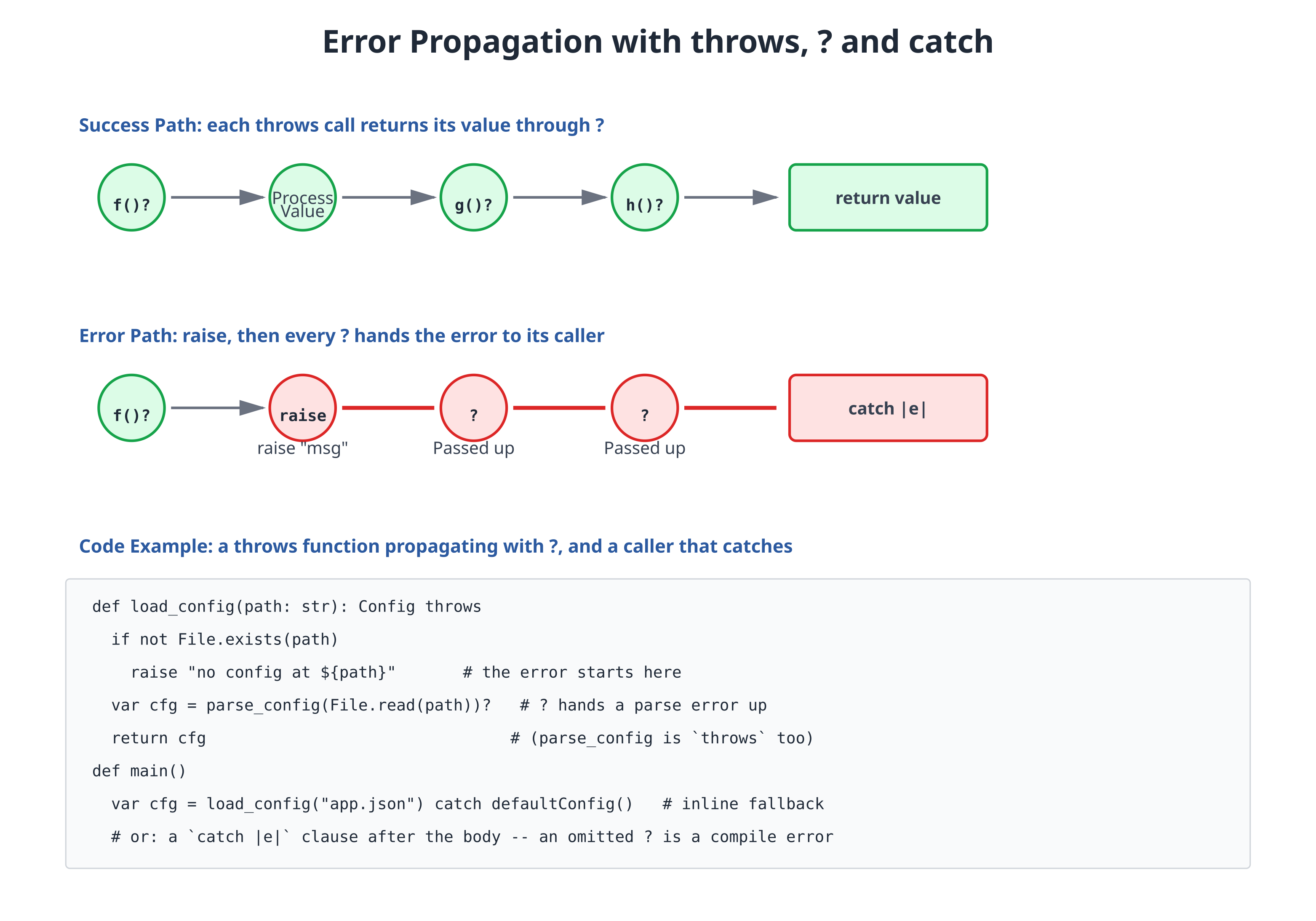
Functions annotated with throws can propagate errors from callees, but propagation isn't automatic — mark the call with ?. If a throws function calls another throws function without catching, the ? sends the error straight to the caller:
# file: 12_propagation.zbr
# teaches: error propagation
# chapter: 12-Error-Handling

class Parser
    static
        def parse_config(text: str): str throws
            if text.len == 0
                raise "Empty config"
            return "parsed"

class System
    static
        def load_system(config_text: str): str throws
            # The `?` sends a raise from parse_config straight to our caller
            var parsed = Parser.parse_config(config_text)?
            return "System loaded with: ${parsed}"

def main()
    var result = System.load_system("data") catch "load failed"
    print(result)
Real World: API Client
# file: 12_api_client.zbr
# teaches: realistic error handling
# chapter: 12-Error-Handling

class APIClient
    static
        def fetch_user(user_id: int): str throws
            if user_id <= 0
                raise "Invalid user ID"
            if user_id == 1
                return "Alice"
            raise "User not found"

        def fetch_and_greet(user_id: int): str throws
            var user = fetch_user(user_id)?
            return "Hello, ${user}!"

def attempt_greet(user_id: int)
    var g = APIClient.fetch_and_greet(user_id)
    print(g)
catch |err|
    print("Error: ${err.message}")

def main()
    # Using inline catch expression
    var greeting = APIClient.fetch_and_greet(1) catch "Could not greet"
    print(greeting)  # Hello, Alice!

    # Using method-level catch (wraps a multi-line block)
    attempt_greet(999)          # prints "Error: User not found"
Exercises
Exercise 1: Safe Division
Write a function safe_divide(a: int, b: int): int throws that raises on division by zero.
Solution
class MathUtils
    static
        def safe_divide(a: int, b: int): int throws
            if b == 0
                raise "Division by zero"
            return a / b

def main()
    var r1 = MathUtils.safe_divide(10, 2) catch 0
    var r2 = MathUtils.safe_divide(10, 0) catch 0
    print(r1)  # 5
    print(r2)  # 0
Exercise 2: Chained Error Handling
Write two functions that chain: parse_age(text: str): int throws and validate_age(text: str): str throws (returns "valid" if age is 0-150).
Solution
class AgeValidator
    static
        def parse_age(text: str): int throws
            if text.len == 0
                raise "Empty input"
            var age = text.tryInt()          # int? -- nil when the text is not a number
            if age == nil
                raise "Not a number"
            return age!

        def validate_age(text: str): str throws
            var age = parse_age(text)?
            if age < 0
                raise "Age cannot be negative"
            if age > 150
                raise "Age too large"
            return "valid"

def attempt_validate(text: str)
    var result = AgeValidator.validate_age(text)
    print(result)  # "valid"
catch |err|
    print("Error: ${err.message}")

def main()
    attempt_validate("25")        # prints "valid"
    var r2 = AgeValidator.validate_age("200") catch "invalid"
    print(r2)  # invalid
Next Steps
- → 13-Generics — Type-safe containers
- → 15-Pipelines — Chain operations gracefully
Key Takeaways
throws— Annotates functions that may failraise— Signals an error, exits the function immediately- Method-level
catch— Attach acatchclause to adefat the same indent level; it runs when anythrowscall in the body raises catchexpression — Inline fallback:expr catch default- Errors propagate with
?— Mark every call to athrowsfunction with?to send its error to the caller; propagation is not automatic - Errors are explicit — You always know which functions can fail
Next: Head to 13-Generics for type-safe abstractions.